


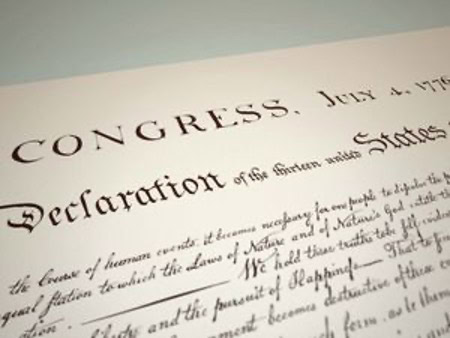
Independence Day, in the United States, the annual celebration of nationhood held on July 4. It commemorates the passage of the Declaration of Independence by the Continental Congress on July 4, 1776. This document announced the separation of the 13 North American colonies from Great Britain. In 1870 the U.S. Congress made Independence Day an unpaid holiday for federal workers, and in 1938 it became a paid federal holiday. Also called the Fourth of July, the holiday is celebrated across the United States with parades, fireworks shows, picnics, concerts, and other festivities. Independence Day is also notable for its displays of patriotism, as many Americans commemorate the day by flying the American flag and dressing in the flag’s colors of red, white, and blue.
HOW DID THE INDEPENDENCE DAY HOLIDAY COME TO BE?
Declaration of Independence
The adoption of the Declaration of Independence, signed July 4, 1776, by the Continental Congress, is celebrated as the Fourth of July holiday in the United States.
The Continental Congress had voted in favor of independence from Great Britain on July 2 but did not actually complete the process of revising the Declaration of Independence—originally drafted by Thomas Jefferson in consultation with fellow committee members John Adams, Benjamin Franklin, Roger Sherman, and William Livingston—until two days later. The celebration of the declaration’s completion was initially modeled on that of the British king’s birthday, which had been marked annually by bell ringing, bonfires, solemn processions, and oratory. Such festivals had long played a significant role in the Anglo-American political tradition. Especially in the 17th and 18th centuries, when dynastic and religious controversies racked the British Empire (and much of the rest of Europe), the choice of which anniversaries of historic events were celebrated and which were lamented had clear political meanings. The ritual of toasting the king and other patriot-heroes—or of criticizing them—became an informal kind of political speech. This was formalized in the mid-18th century, when the toasts given at taverns and banquets began to be printed in newspapers.
In the early stages of the revolutionary movement in the colonies, during the 1760s and early ’70s, patriots used such celebrations to proclaim their resistance to the British Parliament’s legislation while lauding King George III as the real defender of British liberties. However, in many American towns the marking of the first days of independence during the summer of 1776 took the form of a mock funeral for the king, whose “death” symbolized the end of monarchy and tyranny and the rebirth of liberty.